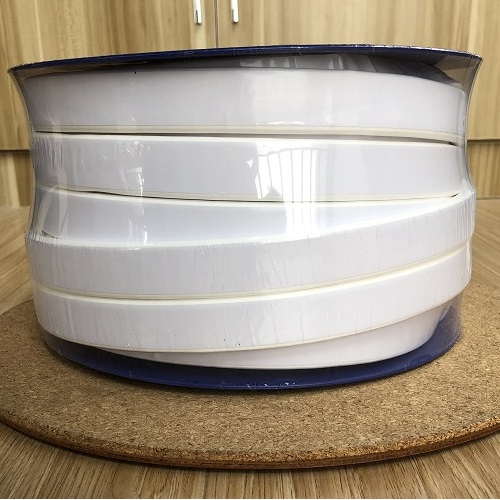
Expanded PTFE joint sealant tape (also called ePTFE joint sealant or self-adhesive PTFE tape) is a soft, highly compressible sealing cord made from 100% virgin PTFE with a self-adhesive backing strip. It is used to seal flanges that are difficult to gasket with a conventional cut sheet — large, complex, irregular, pitted or damaged faces — and where the joint is opened frequently. The tape is simply pressed onto the flange, overlapping at the ends, and the joint is bolted up. It resists nearly all chemicals from pH 0 to 14, works from −268 °C to +260 °C and up to 100 bar, does not hydrolyse or harden, and separates cleanly from the flange after use.
The Expanded PTFE Joint Sealant Tape is an inorganic sealant for static applications made of 100% virgin PTFE. A unique process converts PTFE into a micro-porous fibrous structure, resulting in a sealant with an unsurpassed combination of mechanical and chemical properties. It is supplied with a self-adhesive strip for easy fitting. Expanded PTFE joint sealant is a kind of dynamic seal that can reliably seal the large, complex or damaged flanges. Simply tear the adhesive tape, paste the joint sealant onto the flange surface, select the bolt and pressuriser, overlap the sealant and sealing is achieved — suitable for all standard and non-standard flanges.


The tape is built for the joints that conventional cut gaskets cannot handle — very large flanges, irregular flanges and flanges where the sealing face has been damaged by corrosion, erosion or mechanical impact. These are the features that make it work:
The table below shows the operating limits and physical properties of the KXT 1810 tape. Use these figures for joint design and for verifying incoming material.
The tape is supplied in the sizes below. Format is width × thickness × length. Other sizes can be produced on request — send your required dimensions and we will confirm lead time.
| Width (mm) | Thickness (mm) | Length (m) |
|---|---|---|
| 3 | 1.5 | 30 |
| 3 | 2 | 30 |
| 4 | 2 | 30 |
| 5 | 2 | 25 |
| 5 | 3 | 25 |
| 7 | 2.5 | 20 |
| 7 | 3 | 20 |
| 8 | 3 | 10 |
| 9 | 4 | 10 |
| 10 | 3 | 20 |
| 10 | 4 | 10 |
| 12 | 4 | 6 |
| 14 | 5 | 6 |
| 16 | 5 | 3 |
Tip: swipe the table horizontally on mobile.
Installation does not require special tools and takes only a few minutes, even on a large flange. Follow the sequence below.
Expanded PTFE joint sealant tape is used as a static sealing cord in chemical, food, pharmaceutical and general industrial service — especially where the flange is large, irregular or damaged.
What is expanded PTFE joint sealant tape?
Expanded PTFE joint sealant tape is a soft, highly compressible sealing cord made from 100% virgin PTFE with a self-adhesive backing strip. It is used to seal flanges that are difficult to gasket with a conventional cut sheet — large, complex, irregular, pitted or damaged faces — and where the joint is opened frequently. The tape is simply pressed onto the flange, overlapping at the ends, and the joint is bolted up.
What is the difference between expanded PTFE joint sealant tape and expanded PTFE sheet?
Expanded PTFE sheet is cut into a gasket in the shape of the flange — the whole flange face is covered. Expanded PTFE joint sealant tape is a narrow cord that is laid around the flange face in a ring, overlapping at the ends. Tape is used where the flange is too large, too irregular or too damaged to be covered by a cut sheet, and where the joint is opened often because tape is quicker to replace.
What is the temperature and pressure range of the tape?
The tape works from −268 °C to +260 °C and seals to a pressure of 100 bar. It resists nearly all chemicals from pH 0 to 14 and does not hydrolyse or harden in service. Do not operate at the maximum temperature and maximum pressure simultaneously.
What sizes are available?
Standard sizes are 3 mm × 1.5 mm × 30 m, 3 mm × 2 mm × 30 m, 4 mm × 2 mm × 30 m, 5 mm × 2 mm × 25 m, 5 mm × 3 mm × 25 m, 7 mm × 2.5 mm × 20 m, 7 mm × 3 mm × 20 m, 8 mm × 3 mm × 10 m, 9 mm × 4 mm × 10 m, 10 mm × 3 mm × 20 m, 10 mm × 4 mm × 10 m, 12 mm × 4 mm × 6 m, 14 mm × 5 mm × 6 m and 16 mm × 5 mm × 3 m. The format is width × thickness × length. Other sizes can be produced on request.
How do I install the tape?
Tear off the adhesive backing, press the sealant onto the flange face so that it forms a closed ring, overlap the two ends where they meet, select the bolts and pressuriser, then bolt up the joint. The tape compresses into the flange surface and seals at low bolt load. Do not use more than one layer of tape in the same joint.
Can expanded PTFE joint sealant tape be used on damaged flanges?
Yes. Expanded PTFE joint sealant tape is specifically designed for large, complex and damaged flanges where a conventional cut gasket would not seal. The soft expanded structure flows into pits, scratches and surface irregularities, and the tape format means it can follow any flange shape, including non-standard and irregular flanges.
Page reviewed and updated by the Kaxite technical team · Rev. 2026-01 · Ningbo Kaxite Sealing Materials Co., Ltd, No. 432, Zhenhai Middle Road, Luotuo Street, Zhenhai District, Ningbo City, Zhejiang, China.