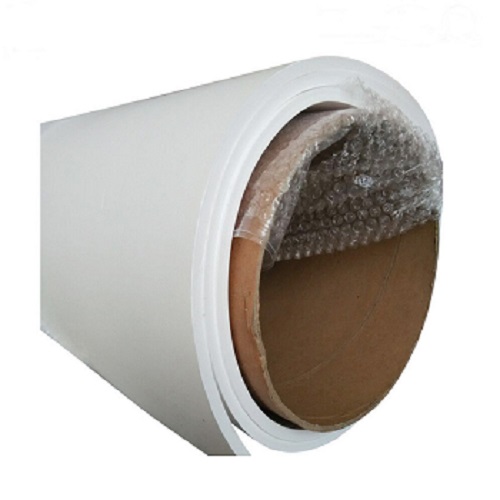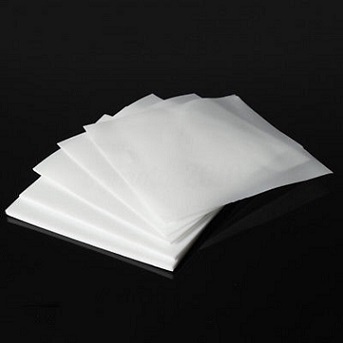
PTFE sheet (polytetrafluoroethylene sheet) is a flat plate product made from virgin or filled PTFE resin. It combines near-universal chemical resistance, a working temperature range of −190 °C to +260 °C, one of the lowest friction coefficients of any solid material, FDA and EU10/2011 food-grade approval and flame resistance to UL94V0. PTFE sheet is produced by skiving for thicknesses below 6 mm and by compression moulding above, giving a smooth, dense surface that machines easily into gaskets, seals, bearing pads, liners and insulators. Kaxite supplies PTFE sheet from 1 mm to 150 mm in standard stock size 1200 × 1200 mm, with anti-static, one-side etched and two-side etched options available for specific applications.
The PTFE sheet is a flat plate product made from virgin or filled polytetrafluoroethylene. It combines near-universal chemical resistance, a working temperature range of −190 °C to +260 °C, one of the lowest friction coefficients of any solid material, FDA and EU10/2011 food-grade approval and flame resistance to UL94V0. Sheet is produced by skiving for thicknesses below 6 mm and by compression moulding above, giving a smooth, dense surface that machines easily into gaskets, seals, bearing pads, liners and insulators. We supply PTFE sheet from 1 mm to 150 mm in standard stock size 1200 × 1200 mm, with anti-static, one-side etched and two-side etched options.
The thickness you need decides how the sheet is made, and the production method affects the surface finish and how the sheet machines. Use the summary below to match the sheet to your application.
Two modified grades solve problems that standard PTFE sheet cannot: static charge build-up and bonding to other surfaces. Both are made to order.
Anti-Static PTFE Sheet
Recommended when static charge needs to be avoided. The sheet reduces static build-up and allows the charge to be grounded safely. Used in semiconductor, electronics, cleanroom and hazardous-area applications where a spark discharge could damage product or create a safety risk.
One-Side Etched Sheet
One face is chemically etched to make it bondable. Used when the sheet needs to be bonded on one side only — for example to a metal backing plate, or where the exposed face must keep the original PTFE non-stick surface.
Two-Side Etched Sheet
Both faces are chemically etched so the sheet can be bonded on both sides. Used as a bonding interlayer between two substrates, or where the sheet is laminated between metal and rubber. Untreated PTFE cannot be reliably bonded.
These are the properties that make PTFE sheet the default choice in chemically aggressive, high-temperature and food-contact applications. Each property is listed with its practical relevance.
PTFE sheet is used as a raw material for cut and machined parts, and as a lining or facing surface in chemical and food-contact equipment.
Both grades are made from the same base polymer. The difference is the additive, which changes the mechanical and thermal behaviour. Use the guide below to match the grade to your application.
What is a PTFE sheet used for?
PTFE sheet is used as raw material for machined and cut parts: gaskets, seals, bearing pads, slide bearings, liners, electrical insulators, chemical tank linings and food-contact surfaces. It combines near-universal chemical resistance, a working temperature range of −190 °C to +260 °C, FDA and EU10/2011 food-grade approval and flame resistance to UL94V0.
What thickness range is available and how is PTFE sheet made?
PTFE sheet is available from 1 mm to 150 mm thickness. Below 6 mm the sheet is skived (peeled from a cylindrical billet on a lathe). At 6 mm and above the sheet is compression moulded. Standard stock size is 1200 × 1200 mm in various thicknesses; other sizes are available on request.
When should I choose anti-static PTFE sheet?
Choose anti-static PTFE sheet when static charge needs to be avoided. It reduces the build-up of static electricity and allows the charge to be grounded safely. Typical uses include semiconductor, electronics and cleanroom environments, and any application where a spark discharge could damage product or create a safety risk.
What is etched PTFE sheet and why is it used?
Etched PTFE sheet has one or both sides chemically treated to make the surface bondable. If the PTFE sheet needs to be bonded — for example to a metal backing, to another rubber or plastic, or with an adhesive — we advise one-side etched or two-side etched PTFE sheet. Untreated PTFE cannot be reliably bonded because of its non-stick surface.
What is the difference between virgin PTFE sheet and filled PTFE sheet?
Virgin PTFE sheet is 100% pure PTFE and offers the best chemical resistance and dielectric insulation. Filled PTFE sheet contains additives such as carbon, graphite or glass to improve specific properties: carbon and graphite improve wear resistance and thermal conductivity, glass improves compressive strength and reduces deformation under load. Choose virgin PTFE when chemical resistance or food contact is the priority, and filled PTFE when mechanical or thermal performance matters more.
Is PTFE sheet FDA approved and flame resistant?
Yes. PTFE sheet is FDA approved and EU10/2011 food grade, and is flame resistant to UL94V0. It is also non-hygroscopic, with water absorption below 0.01%, and UV-resistant, so it does not age in outdoor service.
Page reviewed and updated by the Kaxite technical team · Rev. 2026-01 · Ningbo Kaxite Sealing Materials Co., Ltd, No. 432, Zhenhai Middle Road, Luotuo Street, Zhenhai District, Ningbo City, Zhejiang, China.